
Marco Bello
Marco Bello
Previously, we have reviewed the ARK Fintech Innovation ETF (NYSEARCA:ARKF). That's an active management thematic fund focused on fintech innovation. The first step to review this fund is to select a set of peers and then benchmark it against the top fund. Looking at the 1-year performance, we can see that the fund has outperformed the pack and it has even beaten our benchmark for the technology broad market, the Nasdaq (QQQ).
Seeking Alpha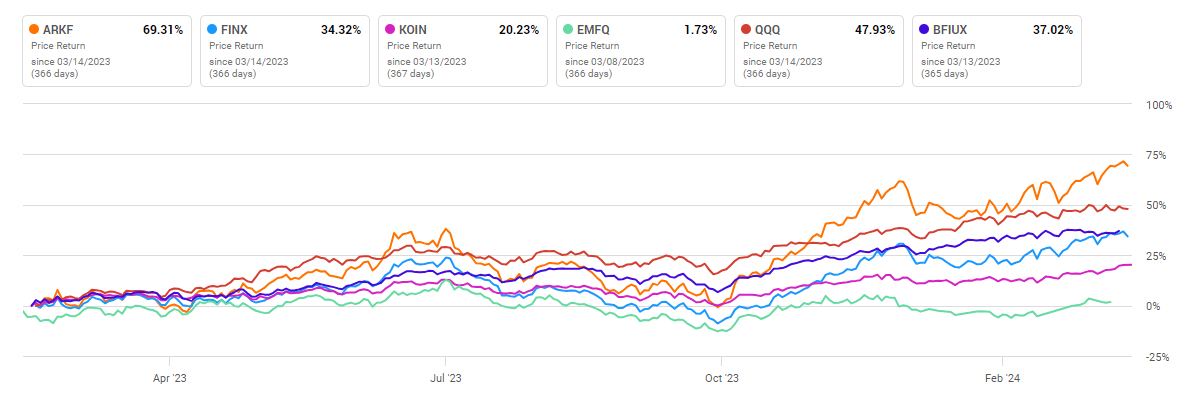
However, when we look at the 5-year horizon, we can see that the fund was narrowly overperformed by the Baron FinTech fund Retirement (BFIUX). This is a mutual fund that also invests exclusively in fintech thematic equities, which makes it a good peer for this comparison.
Seeking Alpha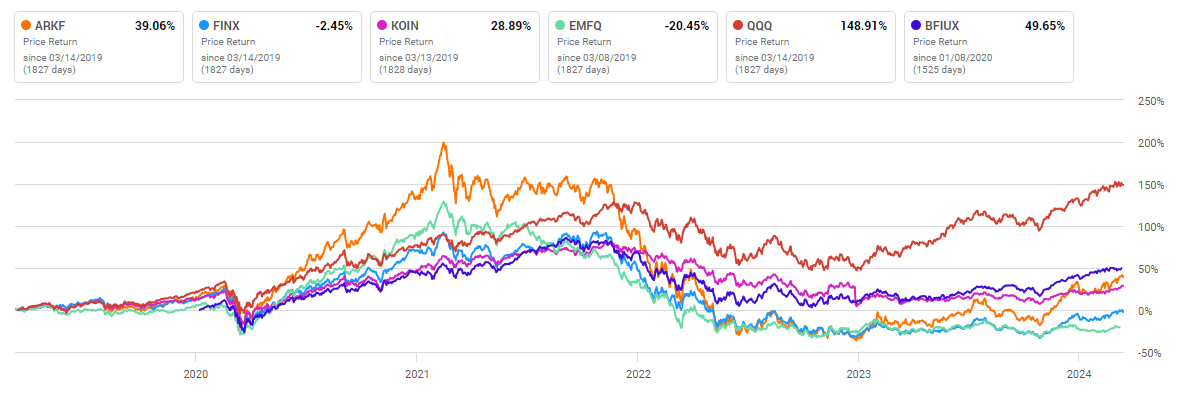
Looking at the top 5 holdings composition for both funds, we can see that they are very different. The Baron's fund is more geared towards more established financial companies, betting on established names like Visa (V) and Mastercard (MA).
Baron Funds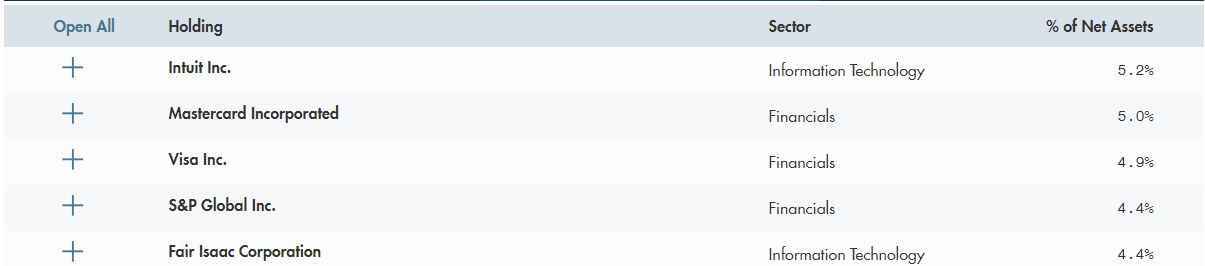
While ARKF is more focused on newcomers and disruptors like Coinbase (COIN) and Shopify (SHOP).
ARK Funds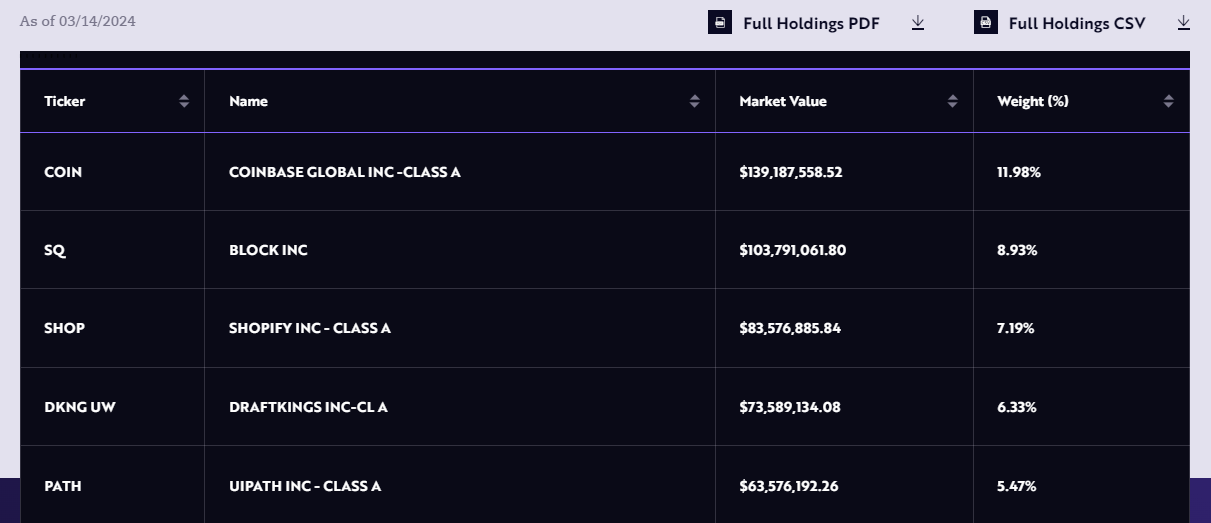
Focusing solely on the top 5 composition doesn't cut it if you're trying to get a real sense of these funds' performance. We need to dive deeper to see that ARKF isn't just throwing its weight behind long shots. It's putting a hefty 40% of its portfolio into its top five picks. That's a stark contrast to Baron's fund, which opts for a more balanced approach, distributing its bets more evenly, with the top 5 summing 23.5%.
Let us now dig deeper into our analysis, and assess if there's a significant difference in the growth prospects and operational metrics for the two funds. When we look at ARKF's top 5 holdings, it's evident that their growth prospects are humming, with each one showing off high double-digit growth.
YCharts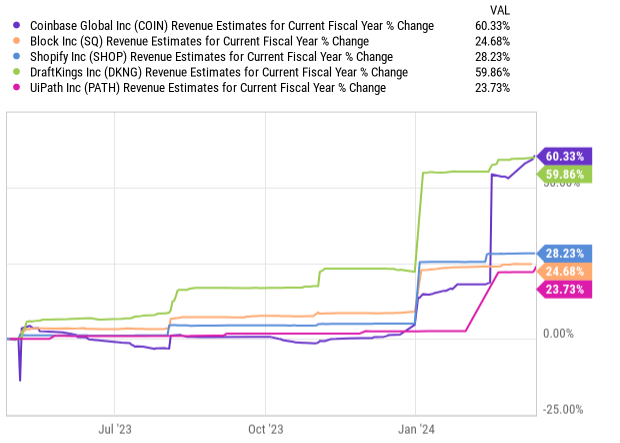
For the Baron's fund, the prospects are also positive, but the growth expectations are a bit inferior to those of ARKF. That is especially significant because the Baron's fund lacks holdings in the top 5 positions with prospects comparable to Coinbase and DraftKings (DKNG).
YCharts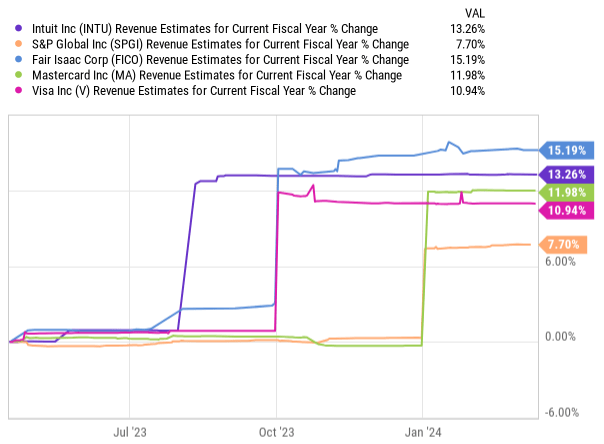
For this type of technology thematic funds, the growth prospects alone are capable of moving mountains, and it helps explain why ARKF has outperformed during the past year.
Now, moving on to the gross margins, we can see that the evolution for the top 5 holdings in the Baron's fund is okay, though not incredible.
YCharts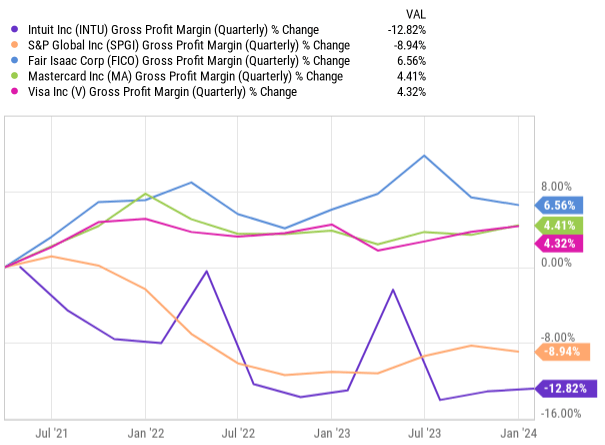
For ARKF there are two companies that clearly stand out and are driving most of the operating performance: Coinbase and Block (SQ).
YCharts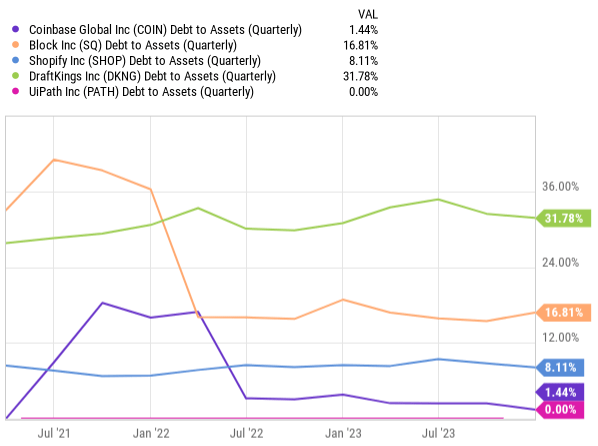
Checking out the balance sheet reveals that ARKF's top 5 holdings are mostly in good financial health, sporting low debt levels and reasonable leverage. Coinbase is the outlier here, but that's in part because it is a broker, by nature Coinbase is going to have a high amount of customer assets on the books. It's just the nature of the beast.
YCharts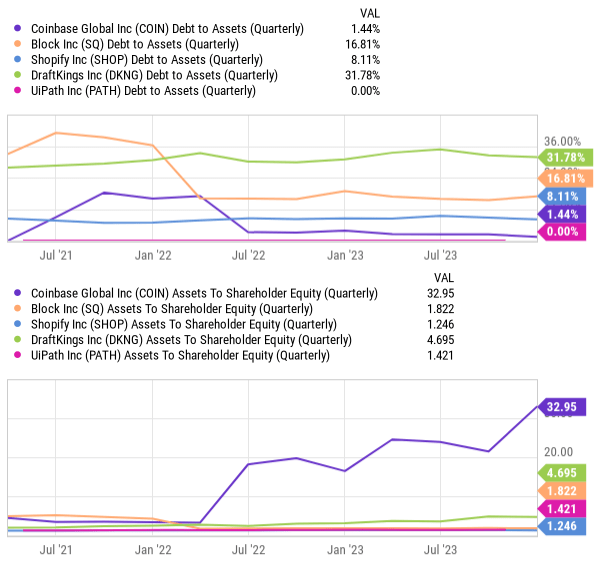
Turning our attention to Baron's fund, we notice it's carrying more financial debt. But let's not jump to conclusions, this isn't necessarily a red flag. We're talking about more established companies here, and their debt levels aren't unreasonable. Their leverage is within a sensible range too. However, Fair Isaac stands out with its negative equity, a curiosity that might deserve our attention on a different piece.
YCharts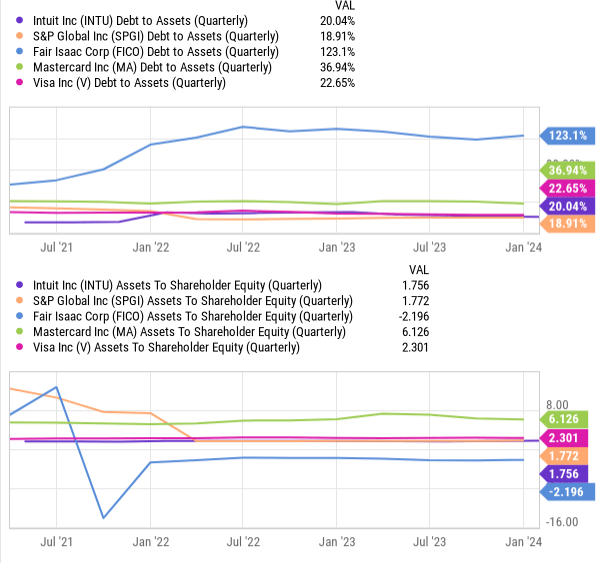
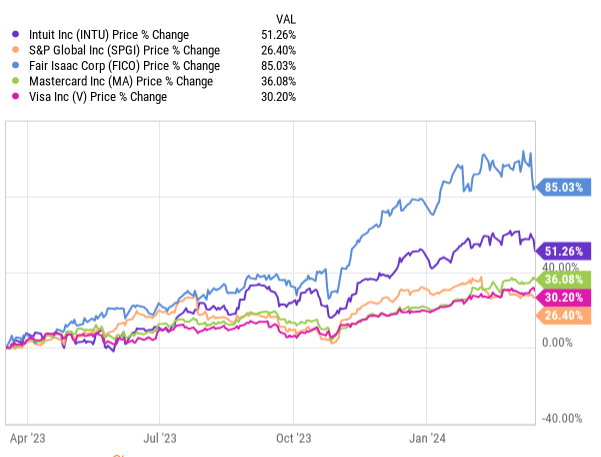
ARKF's approach of doubling down on its top 5 holdings has been a significant factor behind its performance over the past year. That helps to explain the clear outperformance during the last year. The fact that those holdings exhibit higher growth prospects and have been improving their operational performance at a fast pace, has clearly favored the fund.
YCharts YCharts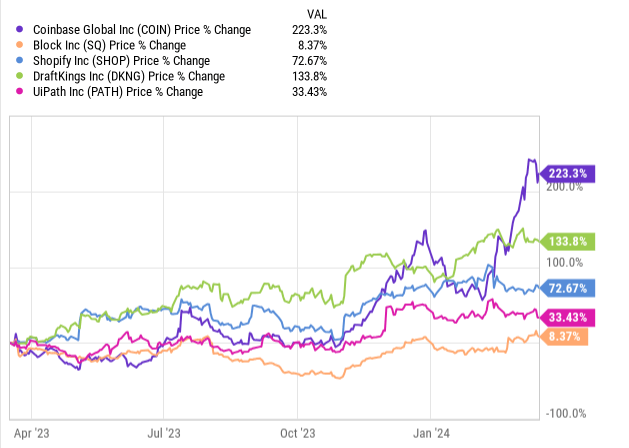
Now, it's crucial to shift our focus to valuation and see how both groups fare. When we look at the Price to Sales ratio, it's clear both groups are trading at high multiples. However, it's Baron's group that takes the lead with even higher multiples. The story doesn't change much when we look at the price to book value either.
YCharts YCharts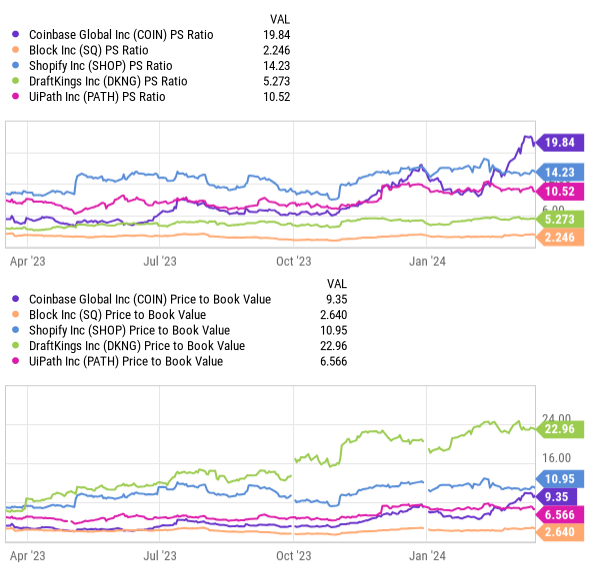
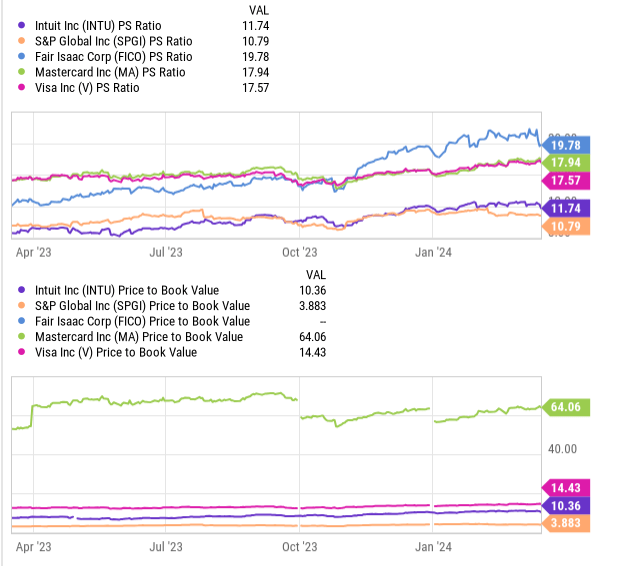
These are very interesting conclusions, given that our expectations were that ARK holdings would have the highest valuation stocks. Now, let's not rush and conclude that ARKF is a value fund. In all fairness, the Coinbase and DraftKings performance have been the main drivers for the fund performance, and they might be more linked than thought. It seems that the current monetary landscape is a productive soil for both crypto and gambling.
American Gaming Association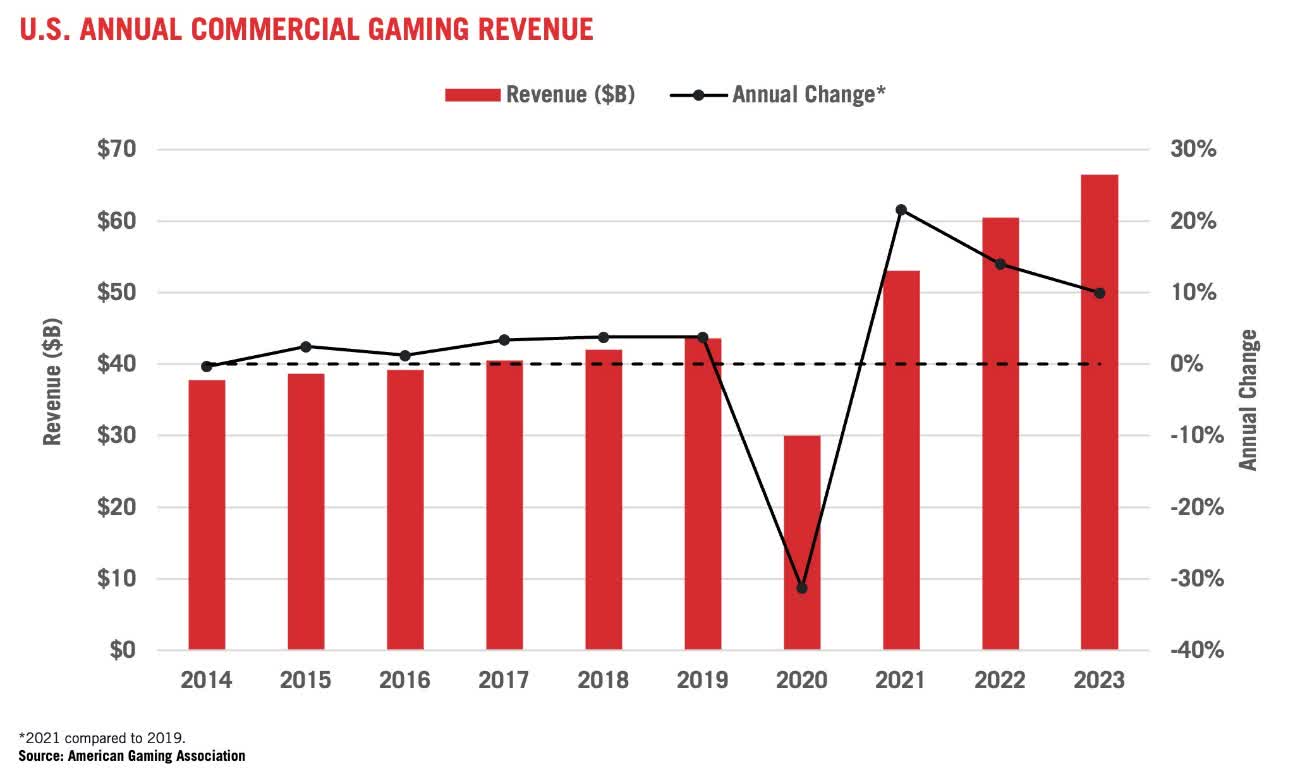
One significant risk in ARK's portfolio composition is its heavy bias towards two main sub-themes: crypto and gambling. While I'm bullish on crypto, especially Bitcoin, and see Coinbase as potentially becoming a powerhouse in the sector, the gambling theme's success seems more short-lived. It may be riding high on temporary monetary quirks, a performance that might not be sustainable in the long term.
Additionally, a concerning factor for these fintech-themed funds emerges when we extend our view to a longer timeframe, let's say 5 years. It becomes evident that only during a brief period around the Covid outbreak did fintech-themed funds outperform the Nasdaq. This suggests that investors might be better off keeping it simple and opting for a broad tech market fund like the Nasdaq, rather than overcomplicating their strategy with specific thematic funds that only outperform periodically (and unpredictably).
Seeking Alpha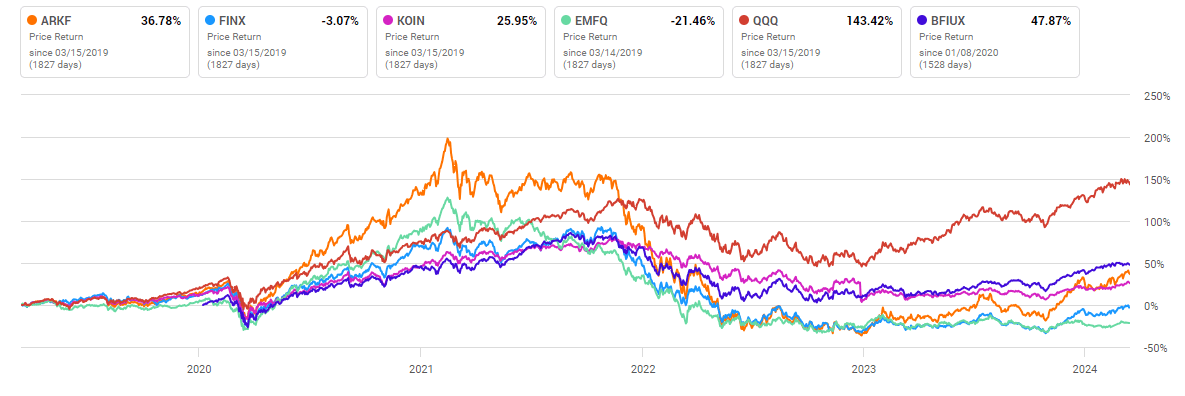
That is a harsh conclusion given all the effort that we have put into this piece, but the truth is that the Nasdaq already includes some fintech names, while also including other technology themes and all that for a smaller fee. For less money, investors have better performance while carrying less risk exposure.
YCharts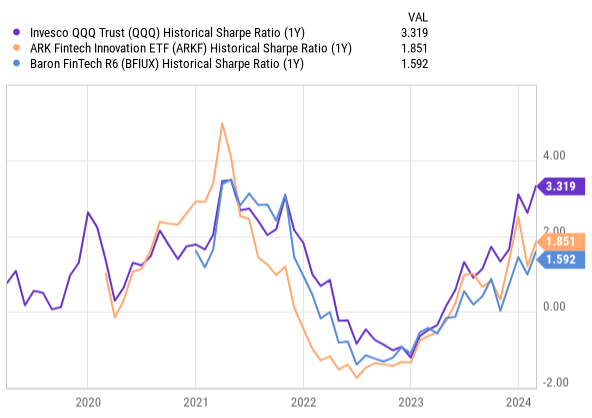
Editor's Note: This article covers one or more microcap stocks. Please be aware of the risks associated with these stocks.