
J Studios/DigitalVision via Getty Images
J Studios/DigitalVision via Getty Images
I've become a big believer in BDCs (business development companies) because of the strong dividend cash flow they can provide. Capital Southwest (NASDAQ:CSWC) has been one of my strongest BDC holdings and has consistently provided me with a growing stream of income. As a bonus, the price of CSWC has also grown by nearly 130% over the last decade. The current dividend yield is 9.5% and while lower than some BDC peers like Ares Capital (ARCC), TriplePoint Venture (TPVG), or Golub Capital (GBDC), CSWC has delivered superior total return because of the price appreciation.
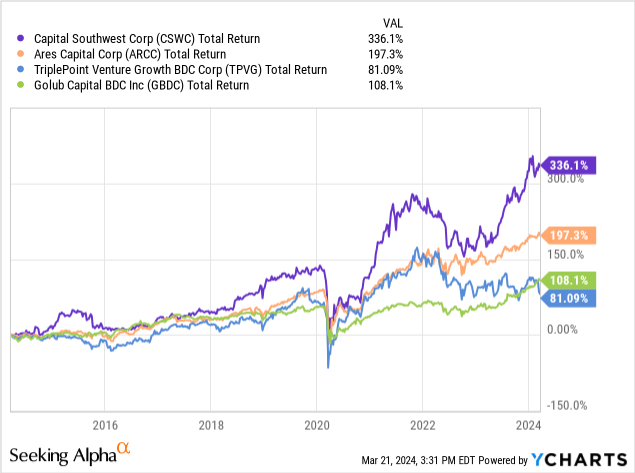
We can see how CSWC outperforms the peer group and delivered a total return greater than 336% over a ten year period. As the price creeps closer to the all time high range, I think this is a great opportunity to take a look on whether or not this price point above $24/share would make for a solid entry point. Despite the recent price run, I want to emphasis that the primary focus of BDCs is to generate income. Looking at the financials proves the efficiency of their portfolio so I have no concerns for the dividend sustainability.
As a quick summary, CSWC is a business development company specializing in credit, private equity, and venture capital investments. Their focus is to lend to and assist middle market companies. CSWC targets growth financing, acquisitions, refinancing, and buyouts for companies within industries such as industrials and healthcare. The BDC seeks profitable companies with revenues above $10 million and may also invest in the upper middle market.
I previously covered Capital Southwest back on the 1st of December, 2023. I rated CSWC as a hold because of the significant premium to NAV at the time of 36.21%. However, I am admitting that I was wrong and over emphasized this as a risk. Since my last coverage, the total return has been over 12% alongside a consistent dividend. Not only has the dividend coverage been excellent, but CSWC also declared two supplemental payments since then of $0.06/share. The first one was paid in December and the next one is upcoming at the end of March 2024. Since my initial coverage, I have had some time to review a lot of different BDCs and I have come to the conclusion that the premium here is well warranted due to well run debt portfolio with a growing net investment record and excellent management.
The stock now trades at an even higher premium to NAV but this is nothing compared against some of its peers. For example, Hercules Capital (HTGC) trades at a premium to NAV of over 60%. Main Street Capital (MAIN) commonly trades at a premium to NAV over 50%. Although we'd all love to enter these positions while the price trades at a discount, the reality is that top tier BDCs rarely do. The only thing warranting the current Hold rating once again, is the anticipation of interest rate cuts. Although I think CSWC is able to successfully navigate those changes, I believe the sector may react to the downside.
CSWC Q3 Presentation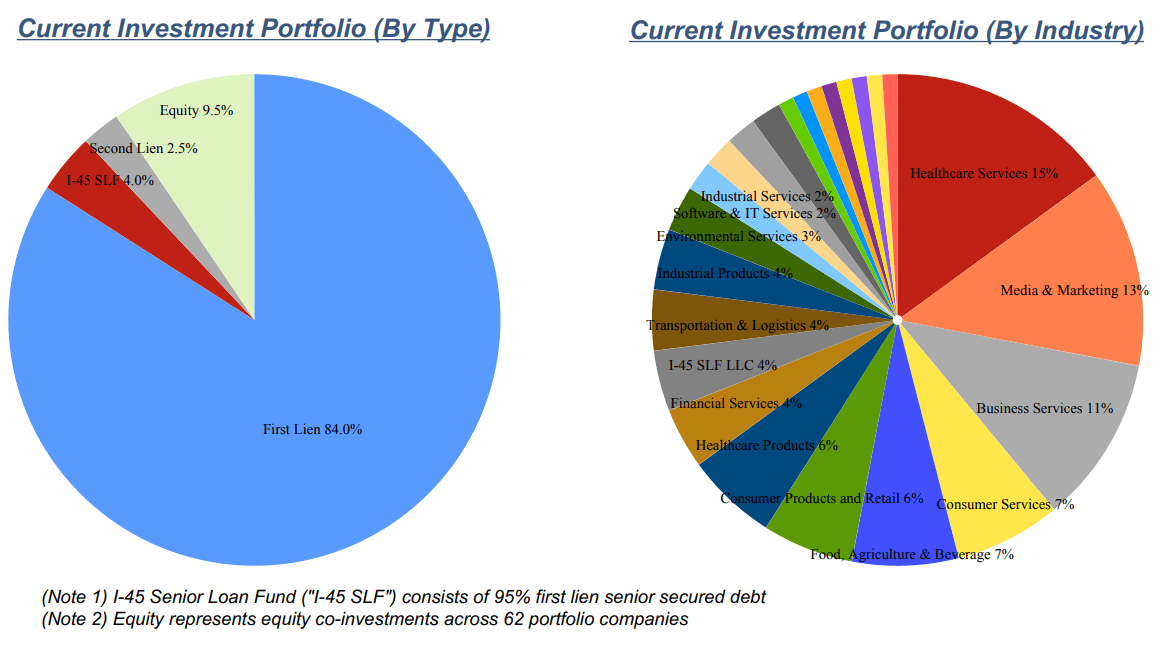
CSWC's portfolio is diverse in nature with the large majority of it within first lien loans. About 84% of the portfolio sits as first lien debt which is reassuring from a risky standpoint. This is great from a risk perspective because of the first lien debt's advantage in the capital structure of repayment. First lien debt has the highest level of priority in repayment during default, bankruptcy, or liquidation of one of the companies CSWC is in business with.
The portfolio is also diverse with the amount of different industries they operate within. Healthcare services holds the majority weight at 15% and this is closely followed by media & market at 13%. While diversity in industry is great, I like to make sure that the debt investments within these spaces are actually beneficial and of high quality for CSWC. Thankfully, the majority of the debt investments have great ratings and only a few loans are rated below average. CSWC has rating system of 1 - 4, where 1 means "of highest quality" and 4 being the lowest rated investment. The breakdown of the portfolio is as follows:
As a whole, the portfolio is really solid and well-rated with an average rating of 1.91 between a total of 120 debt investments. This portfolio composition in addition to the continual total investment income is likely why the price has run up so much as well as why CSWC currently trades at a large premium to NAV. We can see that total investment income grew consistently throughout the entire year.
CSWC Q3 Presentation
As a bonus, CSWC is also actively making strides to fuel growl opportunities within their portfolio. Over the quarter they added $110M in new committed credit investments during the period. The weighted average yield on debt investments currently sits at 13.53% as well.
CSWC reported their Q3 earnings and net investment income rose to $0.70/share. This is an impressive 13% growth compared to the prior year's Q3 net investment income of $0.62/share. The dividend is $0.57/share which means that net investment income easily covers the distributions! In addition, total investment income rose to $48.6M compared to $32.8M in the prior year Q3.
Interest rate cuts are anticipated in the later half of the year. The Fed still forecasts approximately three interest rate cuts this year despite the slight rise in inflation. CSWC's investments primarily consists of floating rate credit exposure. Precisely 97% of the credit portfolio exposure is floating rate while the remaining 3% is at a fixed rate.
This does provide some reassurance that CSWC will remain profitable if rates do come down. However, it does leave some concerns on what the dividends will look like if rates come down and CSWC starts collecting less net investment income as a result.
CSWC Q3 Presentation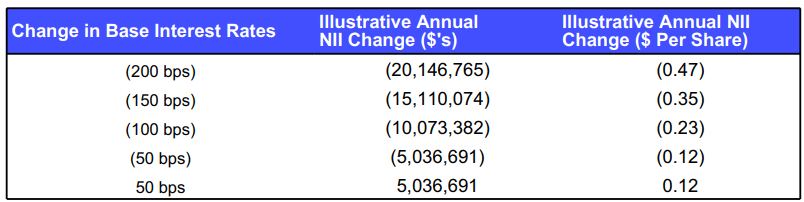
While the plus side is that interest rate cut typically translates to decreased interest expense and borrowing costs for BDCs, it also means that yields on new investments tend to decline as interest rates fall. This will certainly cause NII to decrease. We can see the handy table provided in the Q3 earning slides that gives an estimation of interest rate sensitivity. A (50) bps change will result in a loss of about ($0.12)/share in annual NII. While I do suspect that the abundance of supplemental dividends will likely come to an end, it's still to be seen how CSWC will maneuver and earn enough NII to cover the current distribution.
Q3's NII was reported at $0.70/share. The current distribution is $0.57/share. If we follow the provided interest rate sensitivity table, that means the NII will likely drop to about $0.59/share if rates come down 50bps. While the distribution is still covered in this scenario, the margin of safety is significantly lower than the current coverage it experienced in Q3.
Lastly, lower interest rates could cause increased borrowing. This would technically increase the potential for more defaults. It may theoretically cause BDCs like CSWC to lower their standards and accept lesser quality loans to boost the yield of their portfolio. However, judging from management's excellent investment rating so far this is less of a concern.
As of the latest declared quarterly dividend of $0.57/share, the current dividend yield is now 9.5%. In addition to this dividend, CSWC has also declared a supplemental dividend that's payable March 31st at $0.06/share due to the high levels of income they are collecting. I wanted to take a moment to measure how the dividends received from CSWC would compare to the some peer BDCs such as:
Using Portfolio Visualizer we can see how the dividends have grown for each of these BDCs. CSWC smokes ARCC and TPVG in dividend income growth. This data assumes an original investment of $10,000 with dividends reinvested and no additional capital deployed. We can see how CSWC's dividend growth from 2015 outpaces the peers. Your original $10,000 investment would now be rewarding you with an income of $3,625. In comparison a $10,000 investment in ARCC would have grown to pay you with $2,745 and TPVG would now be paying you $2,835.
Portfolio Visualizer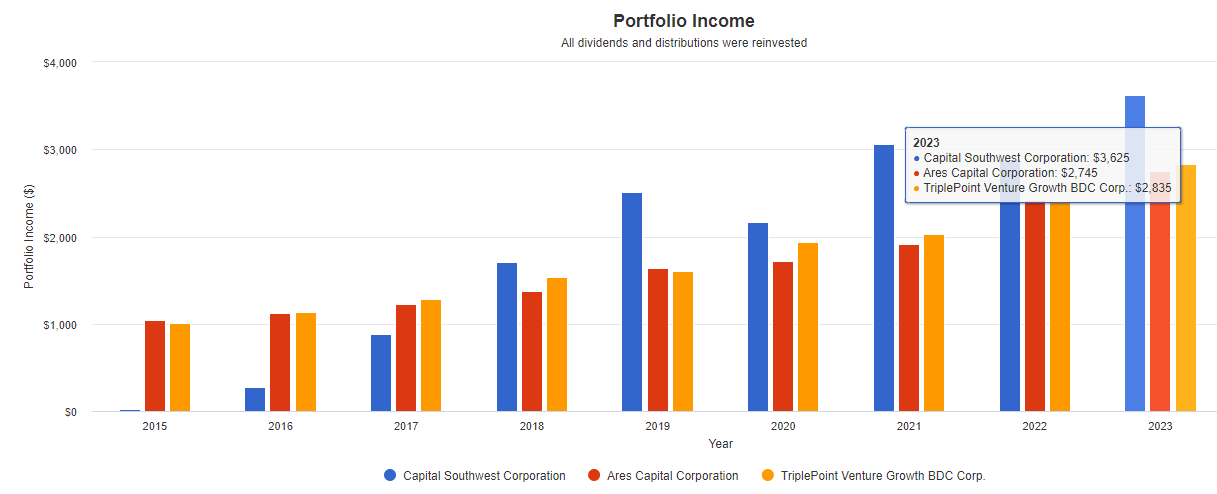
To cement this point, the dividend for CSWC has averaged a CAGR (compound annual growth rate) of 10.33% over the last 5 year period. Zooming out to a 10 year time frame, the dividend CAGR is an impressive 21.26%. Considering that this is a BDC that already has a dividend yield nearing 10%, this kind of growth is stellar!
In comparison, ARCC's dividend CAGR over a 5 year period was only 4.24% and over a 10 year period it was only 2.36%. TPVG's dividend doesn't have the same length historical data so over a 5 year time frame the CAGR was only 2.13%. Therefore CSWC is the clear winner here displaying the best growth. In addition, CSWC is already earnings enough in NII to withstand a (50bps) drop interest rate and still have the distribution fully covered.
CSWC currently trades at a massive premium to NAV (net asset value) because of the high quality portfolio and excellent dividend growth history. The price currently trades at a premium to NAV of 43.23% which is over the 3 year average premium of 35.07%. We saw the premium climb as high at 73% mid-2021 and as low as a discount of 52% during the 2020 pandemic era crash.
CEF Data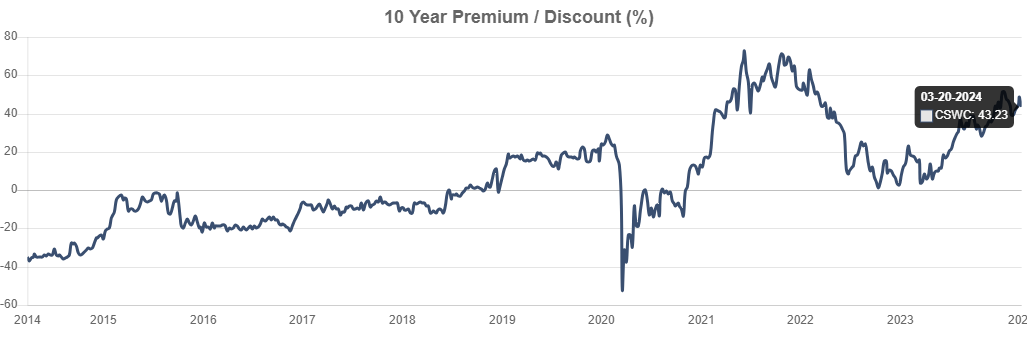
While I do believe this BDC is top tier based on the excellent performance, management, and dividend growth, I stay cautious on adding to my position at these levels. In my opinion the price of most BDCs is likely to retract a bit when interest rates finally do get cut in the later half of the year. When this happens, I believe we will get the chance to add or initiate a position at a much more attractive entry price.
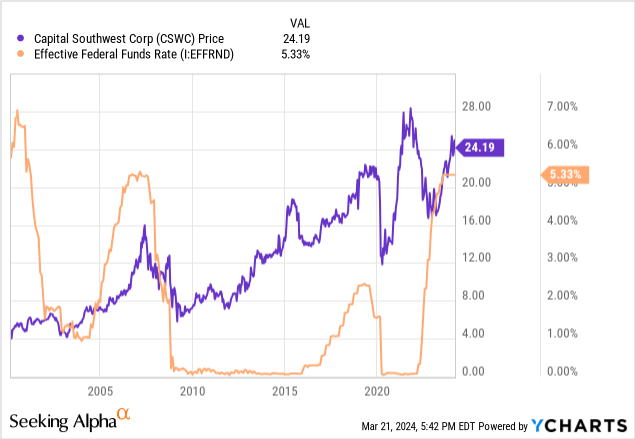
Just for reference, we can see the relationship between the price movement of CSWC when interest rates were cut throughout recent time. 2020 can be labeled as a bit of an outlier due to the circumstances but the price did follow the interest rate cuts. Similarly as rates began to get cut in 2009, we see CSWC's price follow the same pattern. Each time rates were increased, CSWC managed to grow NII and the share price rose alongside NAV. While I do not expect any sort of drastic drop with interest rates, I do think we will get a chance for a more attractive entry in due time.
Capital Southwest remains one of the best BDCs in existence due to the excellent management, well-rated investment portfolio, and stellar total return from price appreciation and dividend growth. CSWC has really benefitted from the rise of interest rates and has rewarded shareholders with increased payouts and several supplemental dividends.
As a result of this strong performance, the stock currently trades at a premium to NAV. The current premium to NAV of 43% is well above the 3 year average premium. The dividend has been well-covered by NII due to the increased margins from interest rates. However, CSWC may be vulnerable to the anticipated interest rate changes in the second half of the year. In Q3 the NII covered the distribution enough to offset any potential loss in NII from interest rates, but this may not always be the case going forward. I remain invested in CSWC and will continue reinvesting my dividends. However, I plan to keep my extra funds on the sidelines to await a better entry once rates are cut.