
Shutthiphong Chandaeng
Shutthiphong Chandaeng
The last that I covered this stock was back in Nov. 2022, and wow, the stock has dropped a staggering 82%.
Looking at past quarters of earnings calls and 10-Q, aside from macro-impact on device sales, it appears to me that most of the underperformance was attributed to management's inability to execute, and some not, including - undermining growth in ST, the loss of its biggest customer - T-Mobile which impacted it's ODS revenue, and migration to a new ad tech platform resulted in short-term revenue decline for its AGP segment due to the loss of lower-margin customers.
While APPS is trading at a discount to peers, I believe it's prudent for investors to wait for a clearer sign of turnaround, and continue to monitor its growth.
Digital Turbine, Inc. (NASDAQ:APPS) is a Mobile AdTech platform that provides publishers with unique access to the home screen of over 800 million devices and also operates an ad tech platform that facilitates end-to-end in-app advertising transactions from DSP to ad-exchange to SSP.
APPS 3Q24 10-Q
APPS worked with OEMs and carriers to provide advertisers direct access to the home screens of over 800 million devices (or users), allowing it to own some of the world's most valuable real estate in the ad industry. In return, this creates monetization opportunities for OEMs and carriers.
However, past performances have been weak. As of nine months ended Dec 2023, revenue has declined 9.8% YoY. This segment was largely due to the lower volume of mobile device sales, and most notably, the unfortunate loss of one of its biggest carrier partners - T-Mobile.
In the past earnings call, management has been working on improving its device pipelines. In its recent 3Q24 earnings call, management highlighted expansion with Motorola to include more devices across more countries and their recent investment in ONE-store, a Korean alternative app store, is expected to add 40 million devices. Additionally, management states that their pipelines are 'robust'.
Keep in mind that this is still a valuable piece of business as OEMs and carriers are looking to monetize their hardware while advertisers need the most efficient way to reach new and existing users, which is enabled by APPS.
APPS has expanded its ad tech platform through the acquisitions of Fyber, AdColony, and Appreciate, enabling end-to-end advertising from the DSP (where advertisers buy ad inventory) to the SSP (where publishers monetize ad inventory). Traditionally, DSPs and SSPs operate independently, leading to data silos and varying fee structures. By integrating the supply chain, APPS gains complete control, allowing for enhanced ad algorithms, reduced costs for advertisers, and increased payouts for publishers. However, this segment has been performing very poorly.
As of nine months ended Dec 2023, revenue declined 30% YoY due to weaker demand and the impact of the integration and exiting of certain legacy AdColony platforms and business lines to modernize their ad-tech platform - what APPS described as a single DT exchange.
According to its 3Q24 and 2Q24 earnings call, as part of the process, APPS chose not to migrate over the long-tail publishers from the legacy AdColony platform - publishers that do not generate significant revenues and are of lower margin, so that they could focus their resources on higher-margin and established publishers. The new platform aims to enable smarter ad space transactions, improve margins, and provide better returns on ad investments for customers. However, this resulted in short-term revenue losses, and additional expenses were incurred for having to maintain the current legacy system and migrate over to the new platform.
Due to this segment not performing to expectations since the acquisitions, it is prudent for shareholders to monitor its growth moving forward.
Launched in 2021, SingleTap (ST) is APPS' self-developed tech and its biggest value proposition lies in helping advertisers to increase conversion rates by enabling the installation of apps with just a single click. What was meant to be a significant growth driver has yet to come to fruition.
Not so long ago in 1Q24, analyst Dan Day mentioned that management was "cautious" about ST's path to material revenue generation, and CEO Bill Stone responded that they continue to be "excited" and it is embedded within 'millions' of devices and cited several publishers in the pipeline with one large social media platform - likely Meta, in which they could not disclose. Management has reiterated multiple times in past earnings calls that it will take time for ST to generate material revenue.
Back in the 2Q23 earnings call, management admitted they have performed under expectations:
We do think we're at an inflection point. But we want to make sure that we manage expectations around it, so we don't get over our skis. And those are things in mistakes we made many, many years ago in the past, back to your reference on the dynamic install business. And so, I want to make sure we don't repeat that. So we do want to continue to focus on how we can under promise and over deliver there."
Investor Day Presentation 2021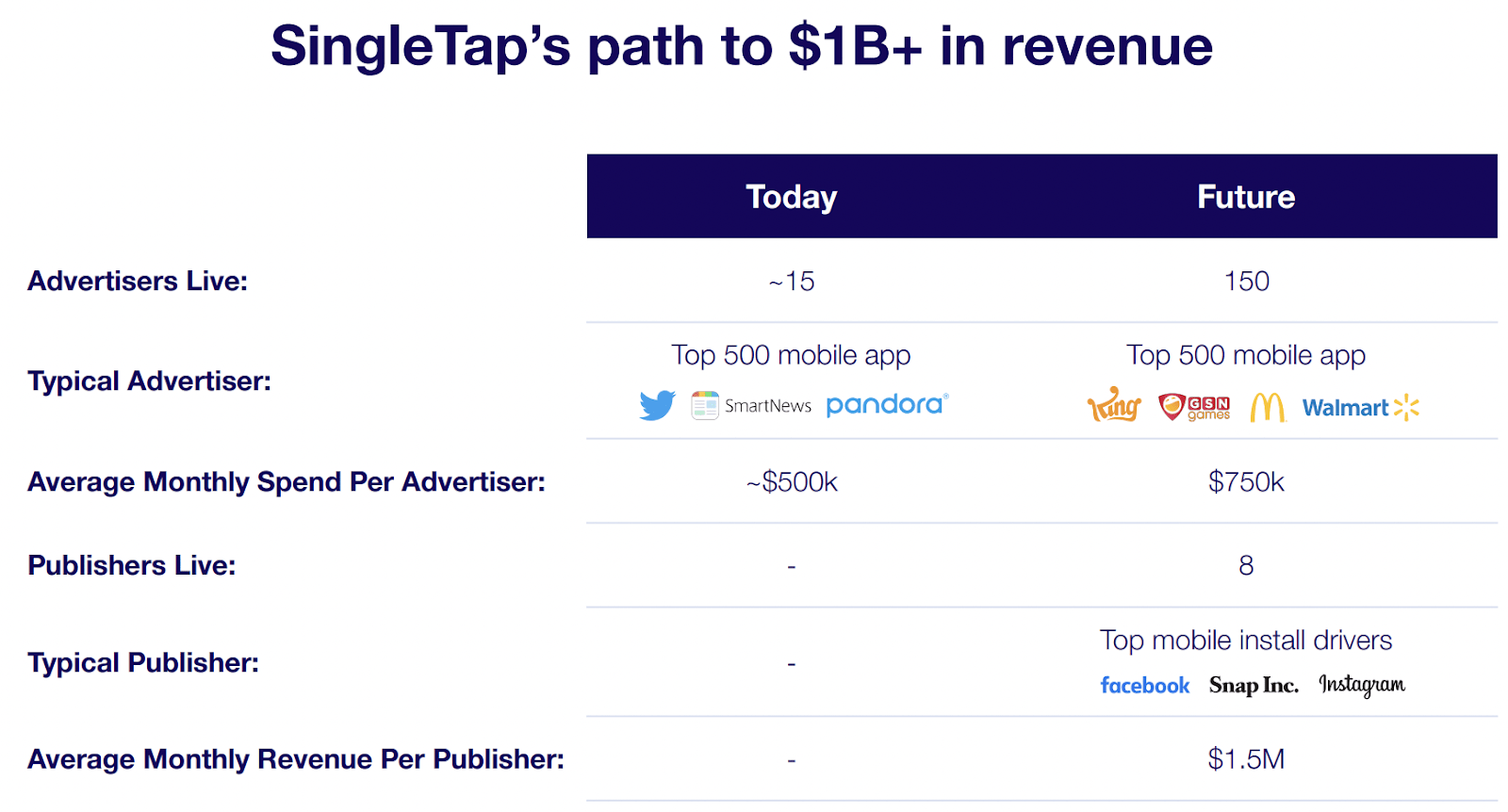
It is not hard to comprehend when back in 2021, the company released ST's potential path to $1 billion in revenue.
To date, ST is live with customers including Google Marketplace, Amazon, Epic, TikTok, and LinkedIn.
Using a quick back-of-the-envelope calculation, taking $1.5 million average monthly revenue per advertiser x 5 advertisers x 3 months would generate a quarterly recurring revenue of $22.5 million, and $90 million of annual recurring revenue. This would imply material growth, which has yet to come to fruition.
It seems to be that analysts and investors are increasingly impatient with ST's growth, and until performance is reflected in the financials, I remain cautious of ST's ability to drive material growth for the company.
One of the biggest upsides is APPS's pursuit of an alternative app store. Most recently, the company made 2 strategic investments in Aptoide and ONE Store. APPS in a joint effort with Aptoide, created GamesHub which primarily serves the U.S. market and it aims to target 80 to 100 million devices by the end of 2023. APPS does that by partnering up with carriers and OEMs to have GamesHub pre-installed on users' devices. ONE store in Korea has access to over 40 million devices in Korea. In addition, APPS will deploy SingleTap across these devices.
This pursuit was also largely because of the Digital Market Act (DMA) in the European Union to crack down on monopolies like Apple. In Jan. 2024, in the EU region, Apple complied by permitting the installation of third-party app stores on IOS devices, lowering commission rates for apps distributed through the App Store (from 17% to 10%), and allowing developers to choose alternative payment systems without paying additional fees to Apple.
I believe that this would pave the way for more monopolies to open up their ecosystem in the future, thus, promoting healthier competition. More importantly, APPS stands to benefit from these regulations.
While this is certainly an upside to APPS' growth, the key to note is that this segment has yet to generate any sort of material revenue for the company.
Author's Valuation Peer Evaluation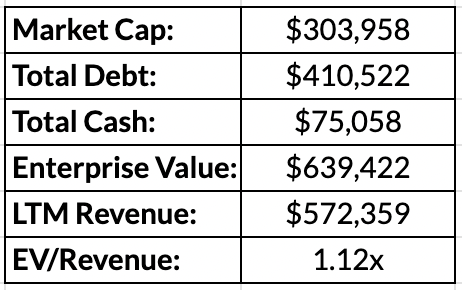

Based on a relative valuation, APPS is trading at a discount to peers. But as investors, it's important to consider the risk-and-return tradeoffs. If we were to factor in underperformance, the current valuation is certainly not as attractive as it seems until there is a clear sign of turnaround.
Digital Turbine has faced significant challenges, including a steep decline in stock price and underperformance attributed to management issues such as the loss of key customers and execution issues.
While their investments in alternative app stores, and regulatory changes like the Digital Markets Act in the EU do benefit APPS, the impact on revenue remains uncertain given it is still in it's early innings.
Considering APPS's current valuation at a discount compared to peers and the ongoing challenges it faces, it may be prudent for investors to adopt a cautious approach and wait for clearer signs of a turnaround before considering investment.